
.png)
Petr Zuzanov
Sep 29, 2026
min

The attack in Part 2 threw off a scatter of alerts from one actor: a management Lambda tampered with and invoked, a burst of thousands of bucket-name guesses, a flood of access-key brute-force calls, and a quiet identity suddenly reading everything in the account. The obvious fix is to point AI at the alerts, one investigation agent per alert. That quietly rebuilds every failure of the overloaded human SOC at machine speed and machine cost. The design that works is the opposite: every related alert attaches to one linked case, and a small set of specialized agents work that case over shared context. Getting that right, especially when new alerts keep arriving mid-investigation, is where the architect earns their keep.
Series: Building the Agentic SOC – Part 3
Part 1: The Security Architect's Next Deliverable: An Agentic SOC
Part 2: Twenty-Five Minutes: One Leaked Key to Account Takeover
Part 3: One Case, Not a Swarm: Organizing the AI SOC
Part 4: The AI SOC Stopped the Attack. A Human Decided It Could
Go back to the Part 2 attack and count what it lit up. A management Lambda whose code and configuration were modified and then invoked. A burst of twelve thousand bucket-name guesses against S3. A flood of access-key creation calls hammering IAM in a brute-force pattern, with new keys appearing on several users. And, at the end, a normally quiet identity suddenly enumerating IAM, S3, Secrets Manager, and SSM. Four kinds of detection, on different resources, spread across the same half hour.
They are not four problems. They are four fragments of one attack: a single stolen key, a single chain from a hijacked Lambda to a brute-forced admin identity. Everything in this part follows from taking that seriously.
So you reach for the tool you now have. You have agents, so you wire one to every alert: an alert fires, an investigation agent spawns, digs in, reports. Four alerts, four agents, all at once. It feels like exactly what agents are for. It is worth being precise about why it is not.
None of these are bugs you can patch. They follow directly from making the alert the unit of work.
The reframe is small to state and changes everything: the thing you investigate is the case, not the alert. Before you spend a single investigation, you assemble the one case out of the four fragments. Four alerts become one case, with one actor, one timeline, one blast radius. Then you investigate that, once.
This is not a new idea. It is what a good analyst does when they recognize that four tickets are the same attacker and merge them, and it is the highest-value work in the room. The problem was never that humans cannot do it. It is that at this attack's speed, no human gets the chance. The point of building it with agents is to do that correlation continuously and instantly, not to skip it.
So the first job of an AI SOC is not investigation. It is assembly: turn a stream of alerts into a small set of live cases, and keep them current as new alerts arrive.
Once the case is the unit, you do not want N identical general-purpose agents. You want a small set of roles with a clear chain of command. Two of them run the case. The rest work it.
Start with the two that most designs leave implicit, and pay for leaving implicit:
Under the leader sit the workers, each doing one job well:
These are roles, not copies. The dispatcher routes, the leader owns and coordinates, the workers each do one thing well.
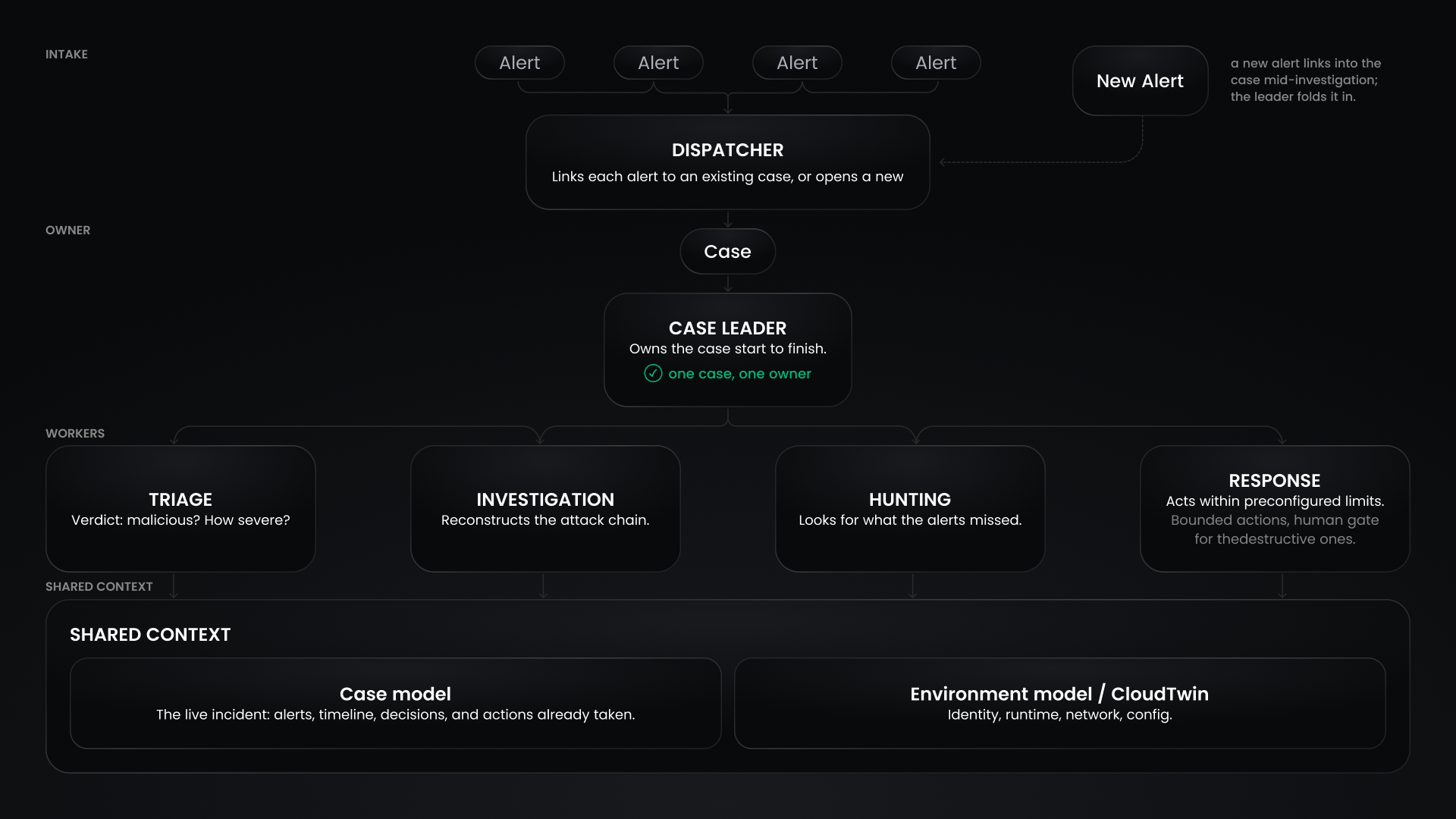
Specialized skills only help if they share what they know. Give each its own private view and you are back to the swarm with fancier titles. What holds it together is a common substrate every skill reads from and writes to: one model of the case, sitting on one model of the environment.
The case model is the live incident: which alerts belong to it, the reconstructed timeline, the resources and identities involved, what is confirmed, what has been done. The dispatcher opens it or attaches an alert to it, the leader maintains it, triage assesses it, investigation enriches it, hunting extends it, response records against it. No agent starts blind.
The environment model is the deeper one, and it is the thread back to Part 1. To reconstruct an attacker's chain you have to know what the environment actually is: which identity can assume which role, which Lambda runs as what, which host reaches which data, how the pieces connect. That is the same map the Security Architect holds. In an AI SOC that map is not documentation, it is a live data structure the agents reason over. Stream.Security calls its version CloudTwin, a unified model of identity, runtime, network, and configuration. Without a shared model of the environment, "correlate these four alerts" is a request no agent can fulfill, because correlation is a statement about how the environment connects, and nothing else holds that map.
Here is the piece that looks simple in a diagram and is genuinely hard in practice, and it is pure architecture.
Assembly is not a one-time sort. Alerts arrive continuously, and they arrive out of order and late, because different logs land at different speeds. So when an alert comes in, the first question is never "investigate this." It is "does this belong to a case that already exists?" If it does, it attaches to that case, and the agents working the case pick it up. If it does not, it opens a new one. Getting that decision right, every time, under load, is the difference between one coherent case and four half-cases that each think they are the whole story.
Now the genuinely hard version, and it is the case leader's problem. Investigation is halfway through a case, building the timeline, closing in on a response, when the dispatcher links a new alert into that same case. The new alert might change the picture completely: it might be the step that reveals a persistence backdoor, or the one that proves the actor already reached data. What does the leader do with its in-flight investigation? Let it finish and risk acting on a stale picture? Kill it and restart, and pay for the investigation twice? Fold the new evidence in mid-flight without losing what it has done? Each choice is a real design with real failure modes: stale decisions, wasted spend, race conditions where two updates to the same case collide.
There is no default answer the vendor ships that is right for every environment. How aggressively the leader re-opens a case, how long it waits for late-arriving logs before it lets a decision stand, when a change is big enough to force a fresh investigation instead of an update, how it keeps two workers off the same resource at once: these are decisions someone has to make deliberately, and they depend on knowing the environment, the log sources, and their timing. That someone is the architect. The concurrency of the case model is not an implementation detail. It is a security design decision, because a case that updates badly is a case that acts on the wrong picture.
Run the Part 2 attack through this instead of the swarm. The four alerts arrive over a few minutes and attach to one case as they land, correlated by the shared principal and the connected resources. Investigation runs once, on the whole chain, and produces one story: leaked key, Lambda weaponized, execution role abused, admin identity brute-forced. Hunting checks whether the same key touched anything else. Response, in Part 4, acts once, precisely. You investigated one case one time, over shared context, with no duplicated work and no conflicting actions. Your cost tracked the number of real incidents, which was one, not the number of alerts, which the attacker controls.
That is the difference between a swarm and an architecture. The swarm scales with the attacker. The architecture scales with the number of real incidents, which is the number you actually care about.
We now have agents organized around one shared, always-current picture of the case and the environment. They can see the whole attack, once, in time. But seeing is not stopping. In Part 4 we watch a real AI SOC take the Part 2 attack apart in the backend, step by step, and then disable the attacker's key on its own, before it reaches anything that matters. And we get to the decision that makes any of that safe to switch on: which response actions you trust the AI to take, which stay in human hands, and why that decision belongs to the architect.
Stream is the AI-native platform built to fight AI-enabled attacks. It autonomously prevents, detects, hunts, and remediates exposures and threats across production at machine speed - driving risk toward zero. It replaces the fragmented stack of scanners, runtime agents, exposure tools and playbooks with one live model of production.Defending Production needs a new approach: Stream is the only Autonomous Production Defense Platform that works across your entire production estate. It runs on a patented CloudTwin®, a high-fidelity security data harmonization layer that models Cloud, SaaS, identity, runtime, AI, network, perimeter, on-prem, security controls, and the behavior running on top of them into one live model of production: real-time, fully correlated, continuously updating. Not a snapshot. And it does not stop at boundaries - the boundaries that fragment every other tool are the same boundaries an attacker moves across. Inside CloudTwin they are one system.


