
Dima Baraz
Aug 5, 2026
2
min
.png)

Stream.Security is expanding workload protection with Response Actions, enabling security teams to contain threats directly from the Investigator UI in real time using the same lightweight eBPF agents already deployed for detection.
When seconds matter, detection alone isn't enough.
Today we're announcing an expansion of Stream.Security's response capabilities: Workload response Actions - the ability to contain threats inside workloads directly from the investigation workflow, executed in real time by the same agents that detect them.
Security teams have long faced a frustrating gap between knowing about a threat and doing something about it. An alert fires. An analyst triages. A ticket is filed. Someone SSHs into a node. Minutes - sometimes hours - pass before containment begins. Attackers don't wait.
Response Actions close that gap.
From the Stream.Security Investigator, analysts can now take immediate action on any monitored workload - whether it runs on Kubernetes (EKS/GKE/AKS), Amazon ECS, or bare-metal/VM infrastructure. No SSH. No separate tooling. No context switching.
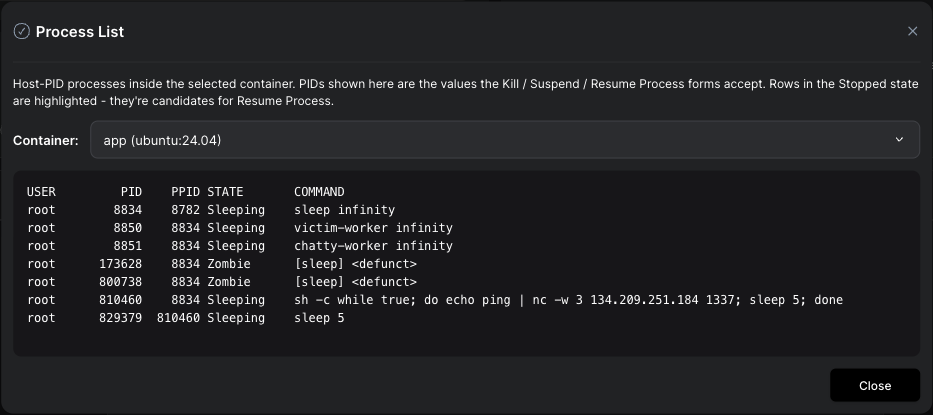
The full action catalog includes:
Process Control
Network Containment
Container & Pod Operations
Filesystem
Advanced
Every action is visible in a live history panel with status tracking, timestamps, and error details - giving the full team visibility into what was done, when, and by whom.

Response Actions are executed by the same lightweight eBPF-based agent already deployed for detection. There's no additional software to install, no sidecar to manage, and no new network paths to open.
The architecture is intentionally simple:
Actions are atomically claimed - if multiple agents match, only one executes. Expired or stale actions are automatically swept. The system is distributed, idempotent, and resilient to agent restarts.
Giving an agent the power to kill processes and block traffic demands rigorous self-protection. Every action passes through a safety layer before execution:
These protections cannot be bypassed by the operator. They are enforced at the agent level, every time.
Cloud-native environments are ephemeral. A compromised container might be gone before a human finishes reading the alert. Automated detection is necessary, but insufficient - the response has to be equally fast and equally close to the workload.
By embedding response capability directly in the detection agent:
StreamForce and the Stream MCP server enable AI-driven orchestration at machine speed. By exposing eBPF response capabilities as tools that AI agents can use, and capabilities like impact simulation. Each AI agent can assess the expected impact of every potential change on the application, then choose the least disruptive path to execute quarantine or remediation.

Response Actions are available today for all Stream.Security customers running the latest runtime agent. To enable:
For questions or to schedule a walkthrough, reach out to your Stream.Security account team.
Stream is the AI-native platform built to fight AI-enabled attacks. It autonomously prevents, detects, hunts, and remediates exposures and threats across production at machine speed - driving risk toward zero. It replaces the fragmented stack of scanners, runtime agents, exposure tools and playbooks with one live model of production.Defending Production needs a new approach: Stream is the only Autonomous Production Defense Platform that works across your entire production estate. It runs on a patented CloudTwin®, a high-fidelity security data harmonization layer that models Cloud, SaaS, identity, runtime, AI, network, perimeter, on-prem, security controls, and the behavior running on top of them into one live model of production: real-time, fully correlated, continuously updating. Not a snapshot. And it does not stop at boundaries - the boundaries that fragment every other tool are the same boundaries an attacker moves across. Inside CloudTwin they are one system.



.jpg)